
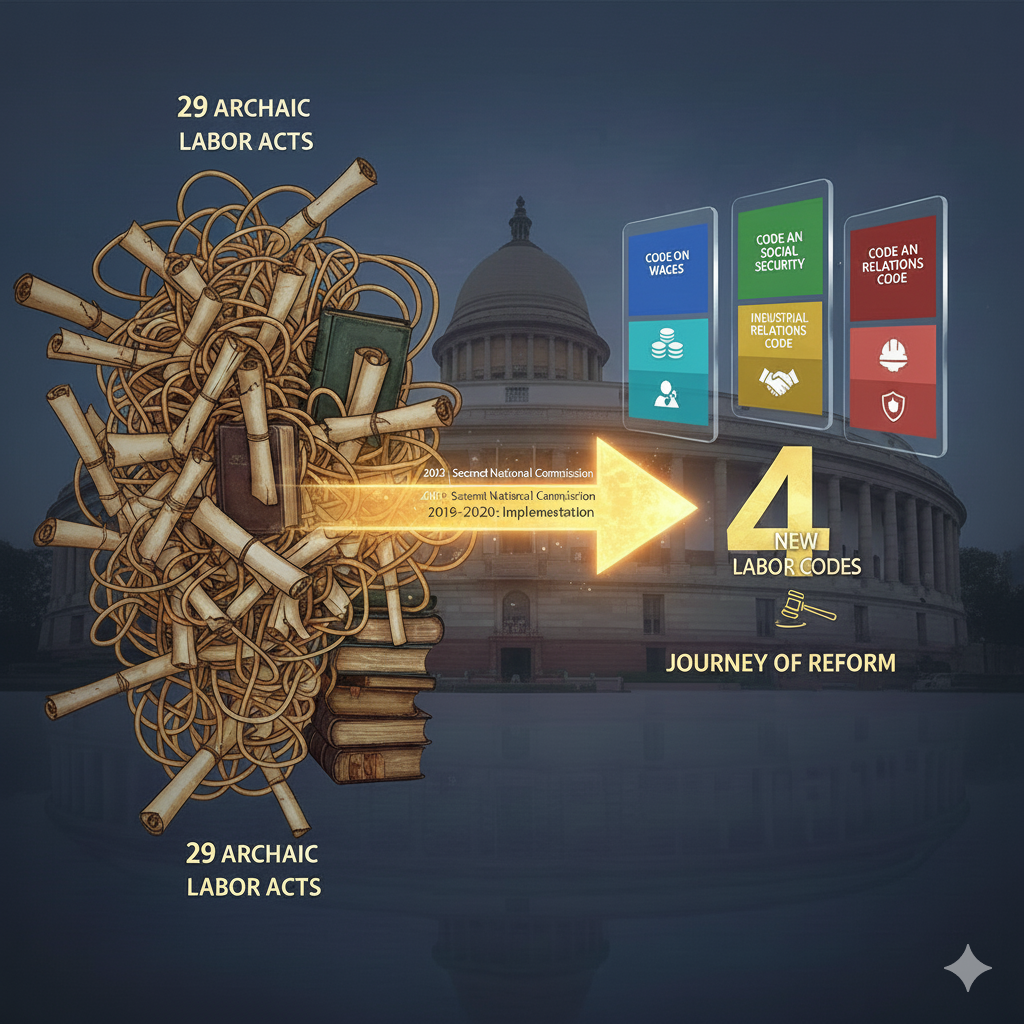
The Origin of the Labour Codes
The formal seed for these reforms was planted by the Second National Commission on Labour, which submitted its report in 2002. The commission found that India had over 100 state laws and 40 central laws governing labor and recommended that existing labor laws should be broadly grouped into 4 or 5 Labour Codes based on function.
The Evolution Timeline
- 2002: The Second National Commission on Labour submits its report recommending consolidation.
- 2002–2014: The idea remained in discussion stages with various committees and consultations but saw little legislative movement.
- 2014: The reform process gained momentum with a renewed push to improve “Ease of Doing Business” while ensuring worker safety.
- 2019: The Code on Wages was the first to be passed by Parliament, subsuming 4 specific wage-related acts.
- 2020: The remaining three codes (Industrial Relations, Social Security, and OSH) were passed by Parliament.
- 2021–2024 (The Delay): Implementation was delayed because “Labour” is a subject on the Concurrent List of the Constitution. This meant both the Central and State governments had to frame their own rules. The Centre had to wait for a critical mass of States to finalize their draft rules to ensure uniform rollout.
November 2025: The Codes finally came into effect, marking the biggest overhaul of labor laws in independent India.


Leave a Reply